
Monday, 13 June 2011
Growing up
We are having terrible weather, wet, windy and not at all conducive to nature photography, however this morning mother wallaby and the youngster were just outside so thought I would show the progress. It is still not weaned and sticks reasonably close to mum, although making a few side excursions for a short time. Both have their thick winter coats and are not particularly bothered by the current conditions.


Tuesday, 7 June 2011
Fringed Helmet Orchid
Found a small patch of Fringed Helmet Orchids Corybas fimbriata this morning amongst the leaf litter as I was tidying up some fallen branches ready for the fire. These tiny orchids are in the peak of their flowering season and this patch about 50cm square had many in flower, just rising above their single leaf.

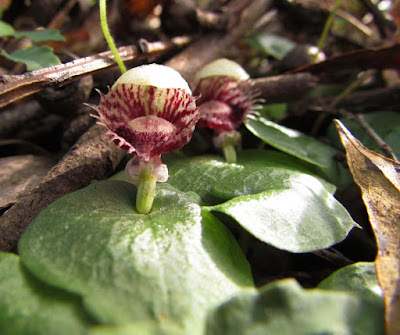

Moist areas in forest, coastal scrub and heath areas with leaf litter, are the habitats for these beautiful little orchids that range through Queensland, NSW, Victoria and Tasmania.
They are one of the 13 orchid species that we have found on our property.

Monday, 6 June 2011
Wattle-less Wattle-bird
Its name Little Wattle-bird anthochaera rufogularis would suggest that it would have wattles even small ones, but like its relative the Spiney-cheeked Honeyeater it lacks the distinctive cheek wattles that distinguish its larger relatives the Red Wattle-bird and the Yellow Wattle-bird.
The Little Wattle-birds range throughout the open forest and coastal regions of south-eastern Australia particularly in areas with Banksias and Dryandras.

Today's visitor arrived at one of its favourite food trees the Coastal Banksia Banksia integrifolia but found that it was in a tree which the Spangled Drongo has designated as its territory. For 20 minutes or so there was much chasing around the tree interspersed with a quick feed from the flower heads. During the break in the chase some shows of defiance by the Little Wattle-bird accompanied by harsh loud challenge calls "Quarr-chock" which the Spangled Drongo would answer with its own harsh cackle and the chase would be on again. Finally the Little Wattle-bird decided there must be easier places to find a meal and flew off.
The Little Wattle-birds range throughout the open forest and coastal regions of south-eastern Australia particularly in areas with Banksias and Dryandras.

Today's visitor arrived at one of its favourite food trees the Coastal Banksia Banksia integrifolia but found that it was in a tree which the Spangled Drongo has designated as its territory. For 20 minutes or so there was much chasing around the tree interspersed with a quick feed from the flower heads. During the break in the chase some shows of defiance by the Little Wattle-bird accompanied by harsh loud challenge calls "Quarr-chock" which the Spangled Drongo would answer with its own harsh cackle and the chase would be on again. Finally the Little Wattle-bird decided there must be easier places to find a meal and flew off.
Saturday, 4 June 2011
Sundew morning, midday cockatoo, afternoon duck.

 We have a patch of sundews Drosera peltata ssp auriculata growing on a grassy slope that gets morning sun and I have been waiting for the flowers . Today the first of the flowers opened and the sun was sparkling on the "dew" drops. I noticed when I checked the photo there is an insect (looks like a mosquito) caught on one of the leaves.
This sub-species is found throughout the eastern states and in NZ where as D.peltata ranges through Sri Lanka SE Asia, Japan, New Guinea and Australia.

Around the middle of the day a pair of Yellow-tailed Black Cockatoos announced they were in the area with their unmistakable call as they flew in, so grabbed the camera and headed in the direction of their calls. The pair were in the trees on the west of the house and I was able to locate them from the noise of branches being ripped apart as they worked to get to the wood borer larva that are their favourite food. The larva could be from one of the moth species, or beetle larva, they are not fussy all are tasty morsels.

Yellow-tailed Cockatoos Calyptorhynchus funereus funereus are the largest of the three cockatoos that we have in the area and are often sighted flying over or in the tree tops and it is when they are grubbing that they are in a position for photos. As well as grubs they are partial to seeds and have found a bonus food supply in pine plantations where they are not particularly welcome or in orchards for their dessert.

They range from central Queensland through south-eastern Australia including Tasmania.

Late this afternoon a pair of Wood or Maned Ducks were on the verge of our road frontage where they are often seen foraging in the grass. This pair raised one duckling earlier in the year but it has now departed and they are empty nesters again. This is one of our most commonly seen ducks as they are foragers on grassland more that water birds although they like a source of water to be nearby. They are found throughout the continent but more numerous away from the centre.
 |
| Male on the left |
Friday, 3 June 2011
Evening Brown
True to its name I found this Evening Brown Melanitis leda bankia just on sunset as it flew in and settled amongst the leaf litter. It is so well camouflaged I am sure you would miss it if you didn't see it move.
This is the first of these butterflies that I have seen or should I say that I have seen close enough to be able to identify. It has two distinct seasonal forms and this is the winter form, although there is considerable variation in both forms (source Butterflies of Australia I.F.B Common and D.F.Waterhouse)
This is the Australian representative of the genus and ranges through north western Australia, Northern Territory, the Islands of Torres Strait and from Cape York down the east coast to about Sydney.
Our property has quite a good supply of one of the larva's food sources,blady grass Imperata cylindrica, so I hope to be able to see more of these butterflies and with luck get a photo with the wings opened.
This is the first of these butterflies that I have seen or should I say that I have seen close enough to be able to identify. It has two distinct seasonal forms and this is the winter form, although there is considerable variation in both forms (source Butterflies of Australia I.F.B Common and D.F.Waterhouse)
 |
| Last rays of sun shining through the wings |
Our property has quite a good supply of one of the larva's food sources,blady grass Imperata cylindrica, so I hope to be able to see more of these butterflies and with luck get a photo with the wings opened.
 |
| With the light on the wings |
Subscribe to:
Posts (Atom)