Wednesday, 11 February 2015

Tenants move the young in.

I was given a Bee apartment house at Christmas by my grand children and within four weeks tenants had taken up residence, but it seems  so far they are wasps.

 Two species have taken advantage of the ready made nursery, with the two grass filled tubes at the top, the nests of a Grass Carrying Wasp. I haven't seen the wasp so the identity is not known, although it is likely to be a species of Isodontia (the only reference I have found is for an American species, Isodontia mexicana,  however it is reportedly also found through Pacific islands)
Two tubes lower left had been filled in by a Mud-nesting  Wasp.
I saw a wasp at the tube two days ago and managed to get a couple of photos (not too sharp) and the identity likely to be a Black Mud-nesting Wasp Hyleoides concinia. 
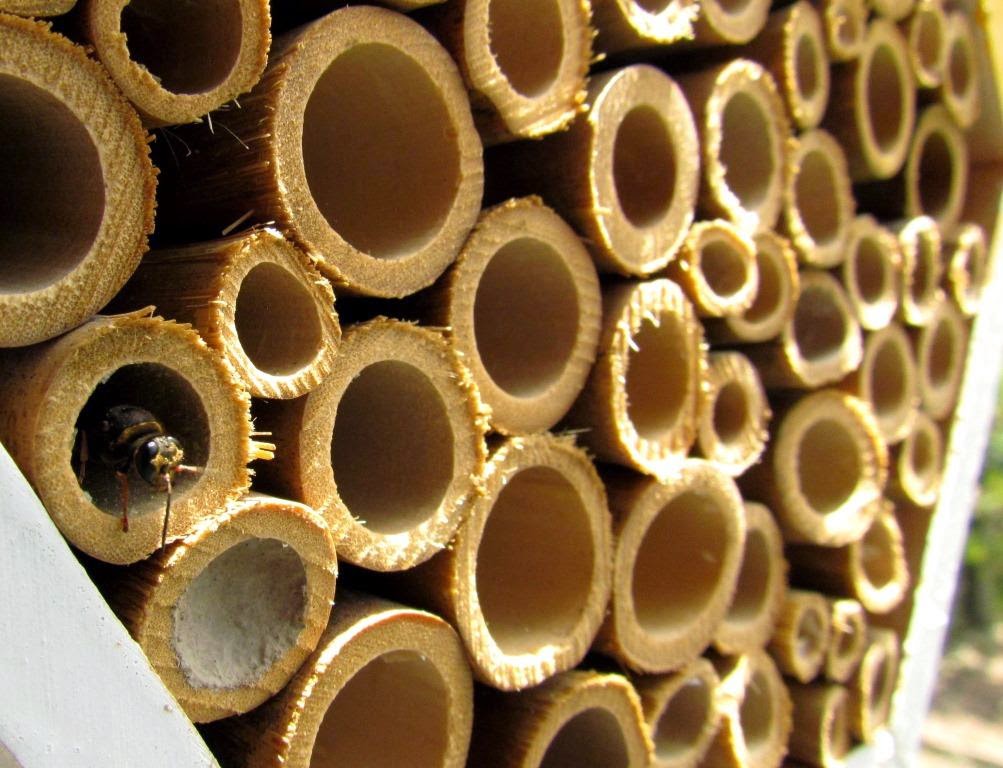


Today a wasp was just putting the finishing touches to its new nest in the tube from where the wasp (2nd photo) is emerging.

Friday, 6 February 2015

Having a sip

The rain and recent hot weather brought lots of mosquitoes, so it has been a summer for plenty of insect repellent when working in the garden or near the bush. The main culprits are the small common mosquitoes but we also see a few of the large greys, that are known as "Hexham Greys" for the area where they are reportedly quite common or "Scotch Greys" which I can only assume is because "they like a drop". One landed on me when I just happened to have the camera in my hand, so I got a couple of photos as it had a sip, then it got slapped.


They are about four times the size of the common mosquito and surprisingly they don't sting nearly as much. In looking up the identity I found there is another that looks very similar so not totally sure that it is Aedles alternans but that is the most commonly recorded, so that is the identity assumed. They appear to be more common towards the tropical regions, however it is not known whether they are carriers of any serious disease.
Fortunately for me mosquito bites apart from being annoying do not cause any itching but there is the risk of Ross River or Barmah Forest fever in our area.


In the last photo the proboscis is just visible and the abdomen is quite full with my blood.

Monday, 2 February 2015

Baby blue

Working in the orchard today with the line trimmer cleaning up around the trees and out of the corner of my eye I noticed a wriggling movement and saw a small lizard. Stopped work and checked out the lizard to make sure it hadn't been hit by the line. I was surprised to see that it was a baby Eastern Blue Tongue Lizard Tillqua scinocides. 

 
Adult Eastern Blue Tongue Lizards can grow to 600mm and are the largest of Australian skinks, however this little one was about 130mm which is about their birth length. The female gives birth to live young, with a litter averaging around 10 individuals.
I moved this little one to an area in the rocks around our pool where it would be less likely to get hit by our mower or line trimmer. It was quite feisty showing its tongue and wide open mouth in display, but hard to get a photo as it did not want to stay still when trying to look tough. I did manage to get one photo with the tongue out but blue colour doesn't show very well.


Tuesday, 27 January 2015

Colour shines through

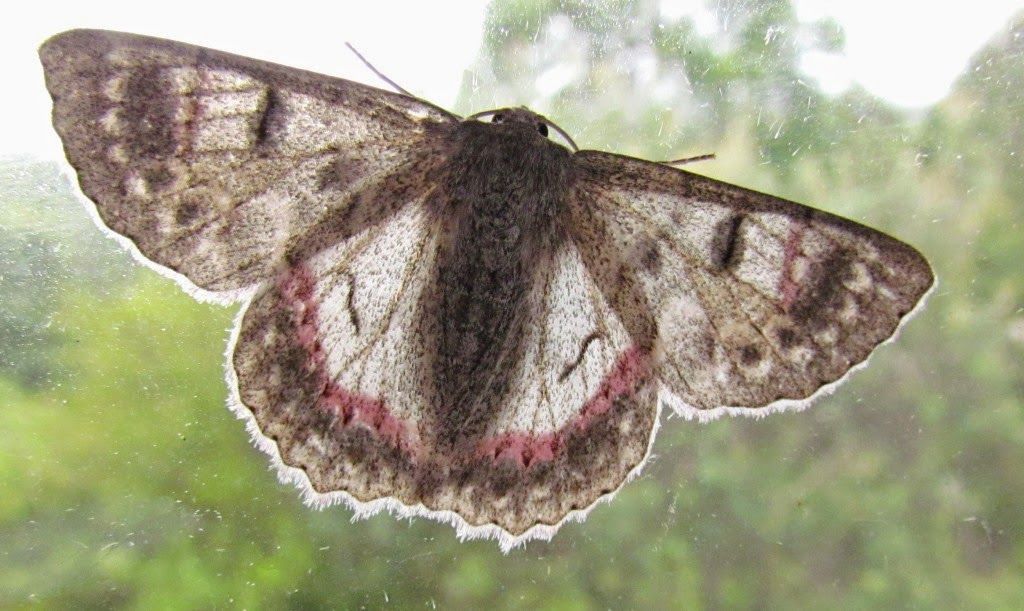
I found a moth resting out of the wet weather on our verandah blind and the morning light was shining through the wings and highlighting the underwing pattern and colours.


The definite pattern and colour I thought would be best for identification,  as the upper wing colour and pattern is less distinctive, as I found when I moved the moth onto a wooden table.


The colour of course is much stronger when viewed directly, as shown when I was moving the moth.

 
It is a female Red-lined Geometrid Crypsiphora ocultaria which is found over most of Australia and the caterpillars feed on Eucalyptus species.

Monday, 5 January 2015

Koel calling

When we lived in Sydney we often had a rude early morning awakening once the Eastern Koels Eudynanys orientalis arrived for their spring & summer breeding season. The repeated call rising in pitch and getting louder the longer it went on would ensure that there was no sleeping in. Here we have not seen them very often and their place seems to be taken by the Channel-bill Cuckoo whose call is also somewhat annoying but not as incessant as the Koel.
I have been hearing Koels around lately and this morning (fortunately not too early) One was calling nearby and then I could hear the "I want food" call of a young one. I found the youngster quite nearby and a poor Noisy Friar Bird trying to keep up the supply of food. I wasn't able to get the feeding photo but did get a shot of the youngster.


The Koel is resident in Northern Australia and the islands to the north but in their southern range they arrive as migrants around September. Nesting medium sized honeyeaters such as Wattle Birds and Noisy Friar Birds as well as other birds of similar size are sought out as the surrogate parents.
The male Koel is glossy bluish black with a bright red iris whilst the female is similar to the young bird. A male has been raiding our vegetable garden to eat some cherry tomatoes as has a young Satin Bower Bird. This afternoon I saw both at the garden but the Koel was a bit flighty and was not cooperative for photos with only one long distance shot with the light behind so the eye does not show the brilliant colour.


The young Satin Bower Bird was more cooperative staying at the vegetable garden. I noticed that is has a problem with one leg which is either deformed or broken but it manage quite well hopping around on the good leg.

.