Showing posts with label Bird: Rainbow Bee-eater. Show all posts

Sunday, 23 February 2020

Bee-eater catches skipper

A flock of Rainbow Bee-eaters has been in the area and their distinctive twittering calls announce their arrival around the house. Today, late in the afternoon I counted ten individuals on our powerline that provided an ideal perch to swoop on any flying insects.

 None of the birds had the long streamer feather of the adult male so I guess they are juveniles and females. I watched them dive after insects and then come back to the wire where they manipulated the prey in a position to swallow. Most took a short time but one came back with a butterfly in its beak and it took a bit of time to get it into the right position, so I managed a couple of photos.

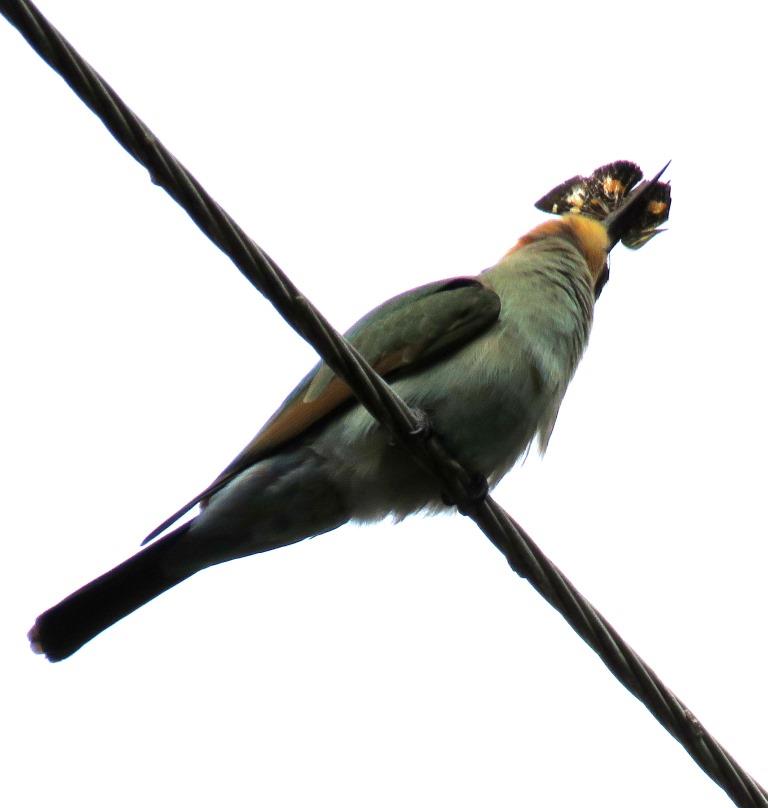
  
The markings on the butterfly wings indicate a Skipper species and my best guess is  
"iacchoides skipper" Trapezites iacchoides although there are a couple of the skippers that are very similar.
Rainbow Bee-eaters really live up to their name and are among the most colourful of birds.


Monday, 10 September 2018

All the colours

My ears picked up a bird call that was not usual at our location so I grabbed the camera and went to see if I could locate the caller. My luck was in, as it did not take any time to find my photo subject. On our powerline a Rainbow Bee-eater Merops ornatus was perched ready to swoop on any insects flying by.


The tail streamer is an immediate indicator to it being a male and then I noticed the female a bit further away on a eucalyptus branch.


I have seen Rainbow Bee-eaters in our area occasionally but this pair was the first I have seen on our property.
Of the 24 species of Bee-eaters in the Merops Genus found worldwide, the Rainbow Bee-eater is the only one found in Australia. Found in all states other than Tasmania, they are migratory spending the winter months in the north and into New Guinea, Indonesia and as far as the Solomon Islands. 

As the name suggests they do have bees as a favourite food source but also wasps and other insects are taken on the wing.