Sunday, 10 April 2016

Tussock tussle

Mowing the grass yesterday and as I passed a patch of long grass I noticed a flash of white as something was blown out of the grass. On stopping to look saw that it was a bright white moth which was now in the typical defensive position which gave me time to get the camera for some photos.


 The white wings were in stark contrast to the hairy body in the curled position displaying smooth green segments and the tan coloured rear end. 


As it became less defensive I was able to turn it for a photo of the upper surface of the thorax and wings.
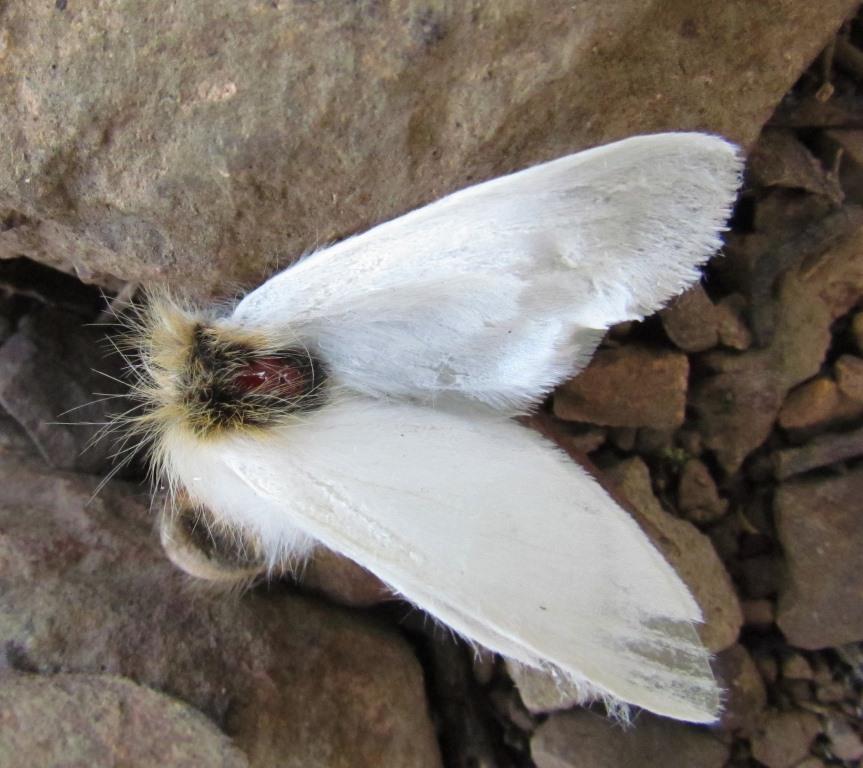

It is a moth that I have not seen previously so I was keen to identify it and thought that it could be in the NOCTUIDAE family and there were a couple of white moths that looked similar but not close enough. I then checked the Tussock moths which are in the same super family of NOCTUDIEA, family LYNANTRIIDAE and found two moths that were a much better match, the Omnivorus Tussock Moth Acyphas semiochres and the White Tussock Moth  Acyphas chionitis. However it was extremely difficult to tell from the reference photos so had to do a lot more searching on the web before deciding it was a female of the former and was the most appropriate identification.
It is widespread throughout Australia and the caterpillars feed on a wide range of native trees and shrubs but in South Australia they have become somewhat of a pest in Pinus radiata plantations. 

Monday, 4 April 2016

ID solved, maybe

I took a photo of a moth in 2011 which I was unable to get enough features for identification but today I think I have found the right species, but there appears to be some question regarding whether there are two distinct species that look very similar or is there just the one.
Today's photo is of a female Epicoma contristis (or tristis)  a species in the NOCTUOIDEA genus found throughout southern Australia whose larvae feed on eucalyptus, leptospermum and kunzea species as well as others in the Myrtacea family.


The photo below is of the male photographed 22/11/2011


Sunday, 3 April 2016

Grass yellow on a gum leaf

Quite a lot of butterflies around at present with our continuing summery weather and I have posted photos previously of most. However one that has been fairly elusive as far as getting a photo has been the Common Grass Yellow Eurema hecabe as they seem to be constantly on the move fluttering from plant to plant and hardly alighting for any length of time.
Today I was in luck as I spotted one that was just warming up after a night that was not that cool but a very heavy dew was coating all the vegetation.

male
 They are distributed through the northern half of Australia with to as far south as Sydney where they are found in autumn where as in the north the adults can be found throughout the year.
The larval food plants include many that can be found on our property such as, Breynia, Acacia spp and indigofera.
 

Thursday, 31 March 2016

More moths

Found two more moths that I have not seen before that I have been able to identify and others that I have not so I am restricting this post to the know species.
The first was attracted by the light through the window and fluttered up and down before settling to allow a photo.


It is the Pink Bellied Moth or Hakea Wine Moth  Oenochroma vinaria and the caterpillars feed on grevilleas, hakeas and banksias. 


The next morning I found this very pretty emerald flat out against the ceiling on the verandah giving me an excellent opportunity for a photo. 
Another of the many Geometroidea family this species is Eucyclodes syn Anisozga pieroides  the Wattle Bizarre Looper whose caterpillars feed on acacia species, roses, macadamias, and Syzygium leuhmannii .
 

Wednesday, 30 March 2016

Procession off track

At present we have a lot of Processionary Caterpillars moving around in a line, that can be quite long (measure one at 5m with over 100 individuals) from one feeding tree (usually an acacia) to another but we found one procession off track heading into the garage.


There was also a little bit of confusion when a break in the line caused a build-up to occur with no leader to head them out.


They are the larvae of the Processionary Caterpillar Moth Orhrogaster lunifer  (photos from an earlier post below)